Tsimtsum
Life of PiTsimtsum is the cargo ship whose sinking transforms the Patel family’s planned migration from Madras to Canada into a disaster at sea. A large, working vessel carrying the family and animals from their zoo, it appears first as a means of beginning a new life and then as the vanished center of an unresolved wreck. Its disappearance drives the novel’s survival narrative, while the later investigation and Pi Patel’s alternative account leave the cause of its loss uncertain.
Background and purpose
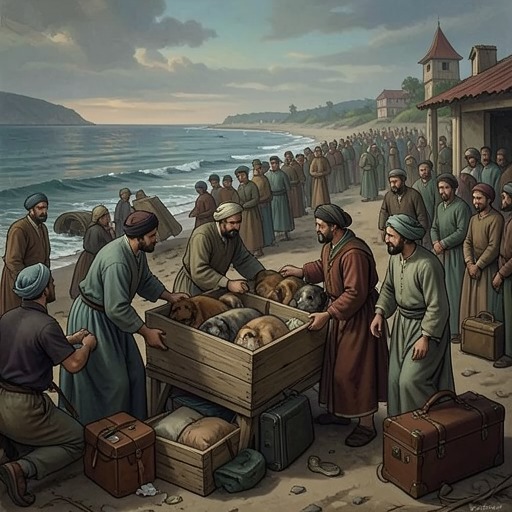
The voyage grew out of the family’s decision to leave a country where political uncertainty and financial pressure weighed on Pi’s father and the family’s zoo. The zoo was a cultural institution rather than a dependable source of profit, and the family’s decision to emigrate promised both a fresh start and a future for the animals. The animals were sold to zoos abroad, with two destined for the Canada Zoo; the broader sale was facilitated by American zoos’ willingness to pay higher prices and by changing international restrictions on trade in captured wild animals.
Moving the collection took more than a year of preparation. Animal transfers required extensive paperwork, permits, health checks, quarantine arrangements, and transport planning. Against that complex background, Tsimtsum carried not only the family but also animals whose relocation was part of the same migration project. The ship therefore represents a practical link between two undertakings: the family’s departure and the dispersal of the zoo’s collection.
The voyage
Tsimtsum left Madras on June 21, 1977. It was registered in Panama, operated by Japanese officers and a Taiwanese crew, and remembered by Pi as large and impressive. Before the disaster, the voyage had seemed orderly and absorbing. Pi marked the ship’s progress on a map, following its route from Madras across the Bay of Bengal, through the Strait of Malacca, around Singapore, and onward to Manila. Looking after the animals filled the family’s days, and the ship’s steady movement made the journey feel secure.
The vessel spent two days in Manila. The stop involved fresh feed, new cargo, and routine engine maintenance. Among the feed was a ton of bananas, and the cargo included a female Congo chimpanzee acquired through Pi’s father’s dealings. Ravi spent time watching the engine work and believed something was wrong with the machinery. Pi paid less attention to the maintenance than to the animals and supplies, and the narrative does not establish whether the work failed or whether an engine fault caused the sinking. The repair and Ravi’s concern remain significant details, not a confirmed explanation.
The sinking and its immediate meaning
After leaving Manila, Tsimtsum entered the Pacific. On the fourth day out, while the ship was midway to Midway, it sank. Pi later recalled waking shortly after four-thirty in the morning after an irregular noise disturbed the vessel’s otherwise familiar background sounds. He went toward the main deck, initially treating the weather as a spectacle rather than recognizing the danger. The ship’s increasing list and water blocking the way below made the emergency undeniable. In the confusion, he saw crew members and signs that the animals had been disturbed, but he could not establish what had happened inside the ship.
Pi suspected an explosion, yet he was asleep when the event began and could not be certain. The account describes the ship’s disappearance as abrupt: the vessel that had seemed as substantial as a continent became a pinprick on the map of the voyage, and the final trace Pi saw was oil on the water. For him, the sinking meant the loss of the ship, his family, and the passage toward Canada as he had understood it. The wreck also left him without a reliable explanation for the catastrophe.
Wreckage, message, and investigation
The sinking continued to shape Pi’s experience after the ship itself was gone. When the lifeboat encountered floating refuse, he searched among the debris for something useful. An empty wine bottle became a possible means of communication. He put a message inside identifying the Japanese-owned cargo ship, its Panamanian flag, the date and location of the sinking, and his situation aboard the lifeboat, then sealed and released it. The bottle turned the vanished ship into a specific report addressed to an unknown recipient: a wreck with a date, a route, a survivor, and an urgent request for help.
Months later, investigators from Japan’s Ministry of Transport interviewed Pi after he reached Mexico. The inquiry could not determine why Tsimtsum sank. The report considered a major hull breach and noted that the speed of the sinking and the quantity of debris were consistent with one, but the precise cause remained unknowable. An explosion was possible, as was a serious engine problem; weather might have contributed, and structural fatigue was also considered. The ship was twenty-nine years old, built in 1948 and refitted in 1970. These possibilities remained conjectures rather than findings, and the report recommended closing the case for lack of conclusive evidence.
Narrative role and competing accounts
Tsimtsum occupies two distinct places in the book’s telling. In Pi’s principal account, its sinking is the threshold between an organized family voyage and an extended struggle to survive at sea. The ship’s earlier steadiness sharpens the reversal: a route carefully tracked on a map ends with the map unable to explain where the vessel went or why. Pi later says that he remembers the ordeal through events and encounters rather than a continuous calendar, so the wreck is both a decisive beginning and a point around which the chronology becomes difficult to order.
The later interview also presents an animal-free version of the sinking as a separate story told by Pi. In that account, four people survive initially, and the Cook helps Pi into the lifeboat. It should not be treated as the investigator’s explanation of the actual cause of the wreck; it is another version offered within the interview’s larger confrontation between story and fact. The official report, by contrast, records what can and cannot be established about the ship’s loss. Together, these frames make Tsimtsum more than a setting for the disaster: its disappearance marks the boundary between a documented voyage and accounts whose meaning exceeds the available evidence.